
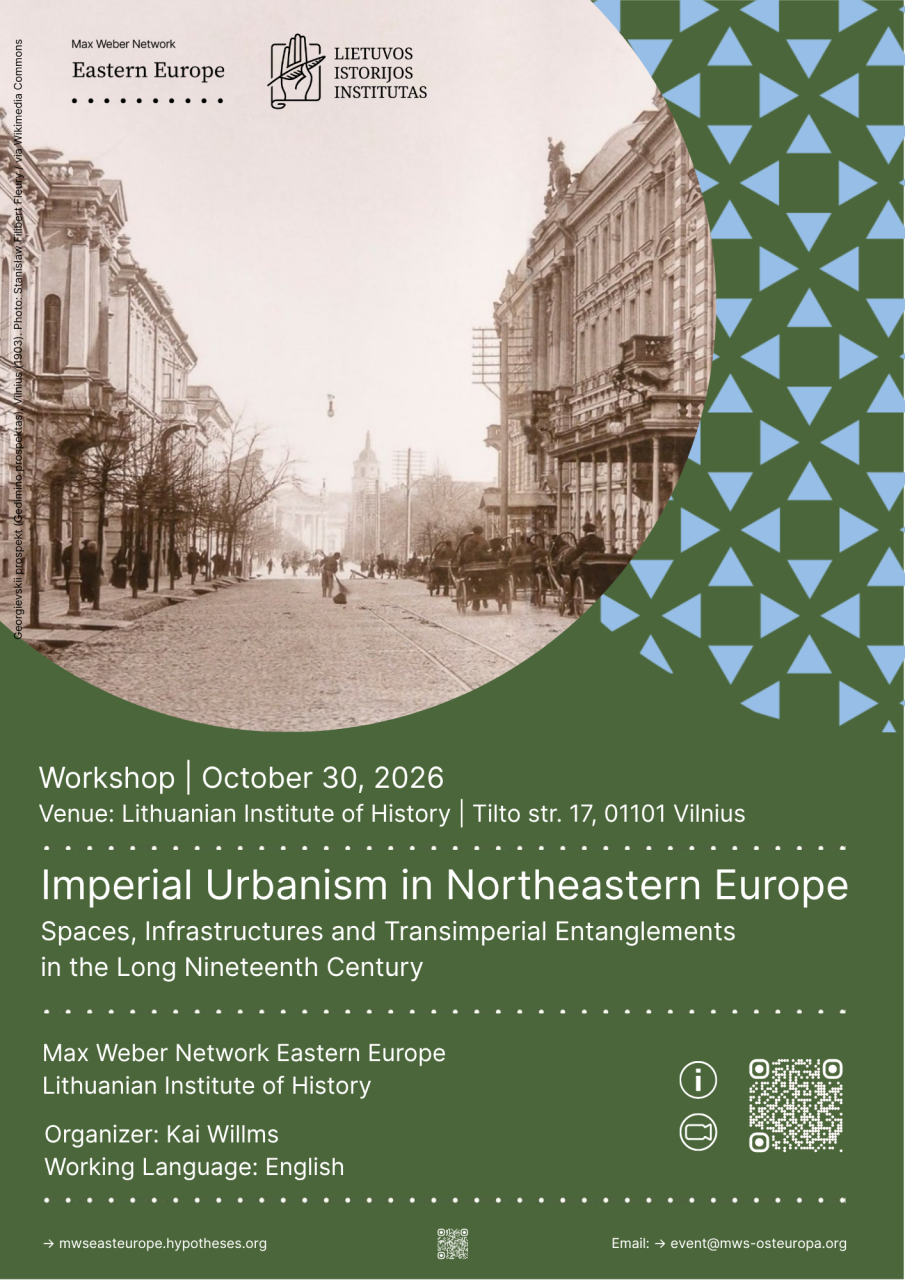
On 30 October 2026, the Lithuanian Institute of History will host a workshop entitled “Imperial Urbanism in Northeastern Europe: Spaces, Infrastructures and Transimperial Entanglements in the Long Nineteenth Century”.
The workshop explores the dynamics of urban development in Northeastern Europe with its specific dialectic of imperial and local agency. Northeastern Europe is often characterised as a region where the social and national ambitions of relatively small ethnic groups (Finns, Estonians, Latvians, Lithuanians, Jews) competed with the attempts of rivalling empires (Russia, Prussia/Germany and, in the more distant past, Sweden and Poland) to secure their rule, as well as with the attempts of ethnic groups originating from these empires (Russians, Germans, Swedes, Poles) to defend their dominant social position.
While such interethnic rivalries are typical of many cities in imperial peripheries, the situation in nineteenth-century Northeastern Europe – including the Grand Duchy of Finland, the Baltic Governorates and the Northwestern Krai – was unique in that the overarching framework of Russian imperial administration coexisted for a considerable time with older, Swedish and German legal traditions of relatively autonomous urban self-government until the Russian imperial state began to pursue a policy of at least partially homogenising urban affairs across the empire, especially in the final third of the nineteenth century.
To what extent was urban ‘modernisation’ in the sense of sociospatial, infrastructural and biopolitical development in Northeastern Europe associated which such homogenising policies of ‘Russification’? What room was there, on the other hand, for the agency of local residents in creating their own visions of urban modernity?
Due to our interest in the specificities of the region, we particularly welcome contributions that look at Northeastern Europe from the standpoint of comparative and/or entangled history. The workshop will explore how these challenges of a changing urban life in nineteenth-century Northeastern Europe were discursively addressed, which practical solutions were found and how the political management of such challenges impacted the social and interethnic relations as well as the imperial hierarchies in cities of the region.
The workshop is organised by Kai Willms (University of Basel / Max Weber Network Eastern Europe Resident Fellow) and the Research Center Vilnius — a joint project of the German Historical Institute Warsaw (DHIW) and the Max Weber Network Eastern Europe (MWNO) — in cooperation with the Lithuanian Institute of History.
The workshop programme is available here.
Venue: Events Hall of the Lithuanian Institute of History, 17 Tilto Street, Vilnius.
The workshop will be held in English.
To participate online, please register here to receive the Zoom link.
