
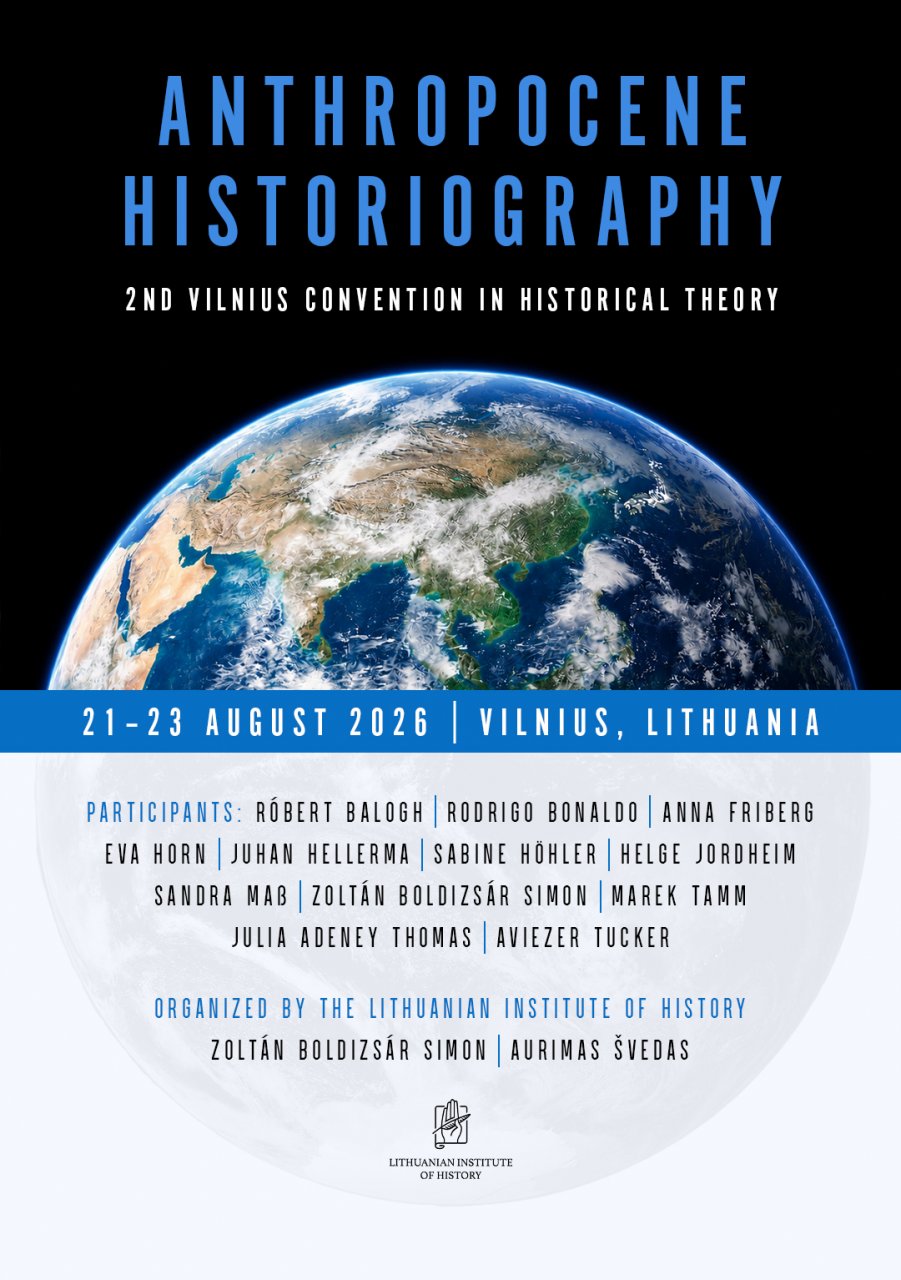
The 2nd Vilnius Convention in Historical Theory will take place on August 21–23, inviting scholars and history enthusiasts to take a closer look at a particularly fascinating and intriguing topic – Anthropocene historiography.
Over the past two decades, the Anthropocene – the proposed geological epoch in which human activity has become one of the primary forces shaping the condition of the Earth viewed as a single system – and the theoretical problems associated with it have been discussed in considerable detail by scholars. However, far less has been said about the more practical question: how should these problems be addressed by historical studies and how would the new concerns of the Anthropocene transform historical scholarship?
The 2nd Vilnius Convention in Historical Theory is dedicated precisely to these questions. How exactly should the historiography of the Anthropocene be written? What is the role of Earth System science in historical research on the Anthropocene? How would a dedicated Anthropocene historiography differ from historical studies of human-environment relations, and how could the two fields collaborate? Does Anthropocene historiography need to develop new structures of argumentation and narrative?
Twelve scholars from nine countries around the world will discuss these issues in Vilnius. This year’s conference participants are: Anna Friberg (Sweden), Aviezer Tucker (Czech Republic), Eva Horn (Austria), Helge Jordheim (Norway), Juhan Hellerma (Estonia), Julia Adeney Thomas (U.S.), Marek Tamm (Estonia), Róbert Balogh (Czech Republic), Rodrigo Bonaldo (Brazil), Sabine Höhler (Sweden), Sandra Maß (Germany), and Zoltán B. Simon (Lithuania).
The main presentations and discussions of the convention will take place on August 21–22 in Vilnius, at the Sapieha Palace. The third day of the convention will be devoted to a visit to the Kernavė archaeological site.
The Vilnius Convention in Historical Theory is organized on the initiative of the Network for Research on the Theory of History, which operates within the Lithuanian Institute of History. The convention’s organizers are Aurimas Švedas, Director of the Lithuanian Institute of History, and Zoltán Boldizsár Simon, Senior Researcher at the Lithuanian Institute of History.
The 1st Vilnius Convention in Historical Theory took place in August 2025. The Lithuanian Institute of History recently published a comic book that creatively conveys the key ideas of the first convention. The illustrator of the comic book “Directionless Times and the Question of History” is Miglė Anušauskaitė, a comic book artist, author, and scholar of Jewish studies. The book is available for purchase at the Lithuanian Institute of History.
