
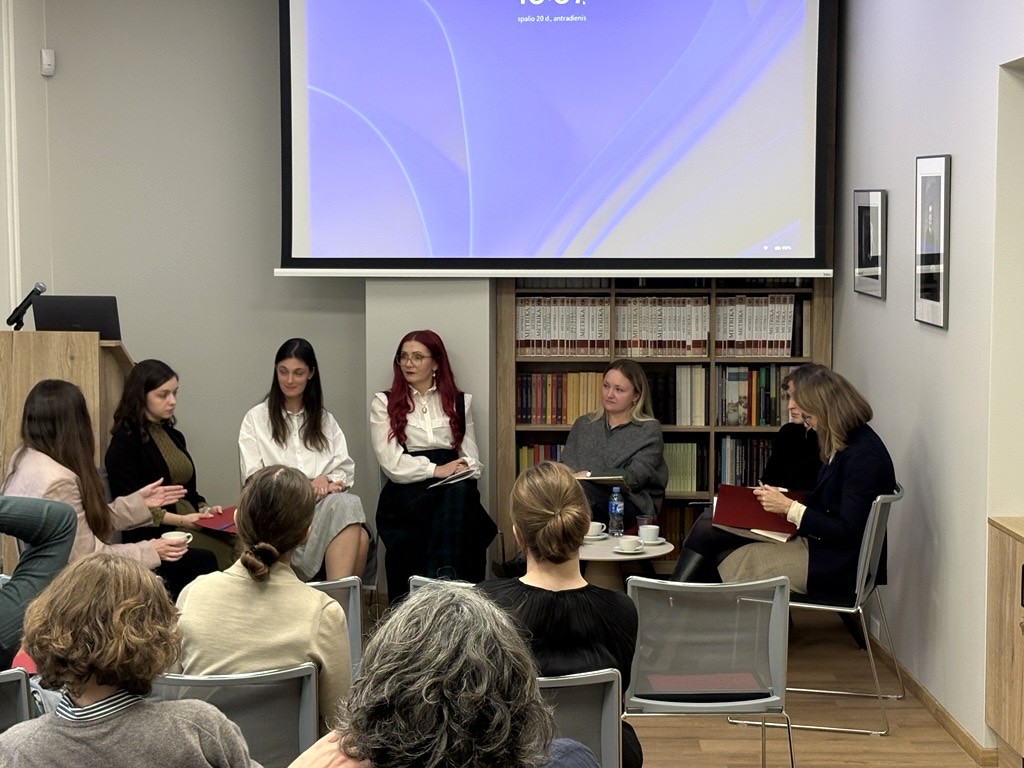
On 20–21 October, the Lithuanian Institute of History hosted the international conference “Mastering Smallness: Strategies and Practices of Small-Scale Actors”. Participants discussed how small states, communities, businesses and other small-scale actors, across different historical periods, sought to preserve their autonomy, resist external pressures and influence broader political, social and cultural processes.
Every two years, the Lithuanian Institute of History, together with the Herder Institute and the Nordost-Institut, organises an international conference for doctoral students and early-career researchers. This year’s conference invited participants to reconsider the concept of “smallness” and its significance in history: does operating on a smaller scale necessarily mean having less power, or can it become an advantage under certain circumstances?
During periods of crisis, political and economic constraints, or intensifying globalisation, small states, communities and businesses are often perceived as rule-takers rather than rule-makers. Historical experience, however, shows that smallness is not necessarily a weakness. Limited resources and positions of power can encourage the search for unconventional solutions, the use of room for manoeuvre, the mobilisation of communities and the development of alternative forms of action.
The conference explored the strategies employed by small-scale actors in different historical periods and political contexts to resist the pressures of homogenisation and monopolisation. By defending national, local or regional interests, these actors preserved distinctive identities, demonstrated resilience and contributed to broader historical change. The topics discussed offered an opportunity to examine historical processes not only through the actions of major powers, political leaders and powerful institutions, but also from the perspective of smaller communities, local initiatives and everyday practices.
The conference brought together 16 doctoral students and early-career researchers from Lithuania, Germany, Latvia, Poland, Slovenia, Austria and other countries. Their presentations covered a wide range of regions, historical periods and research fields. The international academic dialogue provided an opportunity to present recent research, compare different historical experiences and discuss how the perspective of small-scale actors can broaden traditional historical narratives.
The two-day conference programme comprised four thematic panels addressing forms of cultural and political resistance, the autonomy of marginalised communities, local agency under and beyond socialism, and the strategies of small states in the international arena.
